Regulatory Landscape for Gold IRAs 2026: Key Rules and Risks
Regulatory Landscape for Gold IRAs 2026: Key Rules and Risks

Most American investors know that traditional retirement accounts are exposed to market swings and regulatory changes, yet more than 25% of high-net-worth Americans now consider alternative assets like physical gold to protect their portfolios. Defining Gold IRAs and understanding IRS compliance rules matters more than ever, especially for those seeking stability in turbulent times. This guide breaks down what makes these accounts unique, how eligible metals work, and what every conservative investor needs to avoid costly mistakes.
Table of Contents
- Defining Gold IRAs And Core Concepts
- Eligible Metals And IRS Purity Standards
- Custodial Requirements And Legal Oversight
- Tax Rules, Distribution, And Penalties
- Risks, Compliance Challenges, And Common Mistakes
Key Takeaways
| Point | Details |
|---|---|
| Gold IRAs offer diversification | Gold IRAs allow investors to include physical precious metals, enhancing portfolio protection against market volatility. |
| IRS mandates strict compliance | Investors must adhere to IRS regulations concerning metal purity and approved custodians to avoid penalties. |
| Professional guidance is essential | Consult with specialists and tax professionals to navigate the complexities and ensure effective investment strategies. |
| Beware of potential risks | Common pitfalls include non-compliance in metal purchases and fraudulent marketing, necessitating due diligence before transactions. |
Defining Gold IRAs and Core Concepts
A Gold IRA represents a specialized individual retirement account designed to allow investors to hold physical precious metals as part of their retirement portfolio. Unlike traditional retirement accounts that typically include stocks and bonds, gold IRAs enable individuals to diversify their investments by holding physical gold and other approved precious metals directly within a tax-advantaged retirement structure.
The core mechanics of a Gold IRA function similarly to standard retirement accounts, with critical distinctions in asset types and storage requirements. IRS regulations permit specific forms of gold, silver, platinum, and palladium coins and bars to be held within these accounts. Investors must work with specialized custodians who understand the complex regulatory landscape surrounding precious metal investments. These custodians manage the unique storage and reporting requirements, ensuring compliance with federal tax guidelines.
Gold IRAs serve multiple strategic purposes for investors seeking portfolio protection. They can act as a hedge against inflation, provide potential stability during economic uncertainties, and offer an alternative asset class that often moves independently from traditional financial markets. The physical metals are typically stored in secure, IRS-approved depositories, with strict documentation and tracking protocols to maintain the investment’s tax-advantaged status.
Pro tip: Before establishing a Gold IRA, carefully review the specific IRS-approved precious metal types and purity requirements to ensure full compliance and maximize your investment potential.
Eligible Metals and IRS Purity Standards
Investors considering a Gold IRA must navigate strict IRS regulations governing precious metal investments, which define precise requirements for metal types, purity levels, and acceptable forms of physical assets. The Internal Revenue Service permits four specific precious metals for inclusion in retirement accounts: gold, silver, platinum, and palladium, each subject to rigorous purity and quality standards that ensure investment integrity.
The most critical standard involves metal fineness, with gold requirements being particularly stringent. IRS guidelines mandate that gold bullion and coins must achieve a minimum 99.5% purity level to qualify for IRA inclusion. This high standard eliminates most collectible or numismatic coins, focusing instead on investment-grade bullion and specific government-minted coins like the American Gold Eagle, Canadian Gold Maple Leaf, and Austrian Gold Philharmonic. Similar purity thresholds exist for silver (99.9%), platinum (99.95%), and palladium (99.95%), creating a uniform standard across precious metal categories.

Beyond purity specifications, the IRS imposes additional requirements regarding metal form and storage. Approved metals must be physical bars or coins produced by national government mints or accredited refineries, with precise weight and metallurgical specifications. These assets cannot be personally held by the investor but must be stored in secure, IRS-approved depositories managed by specialized custodians who ensure proper documentation, tracking, and compliance with retirement account regulations.
Pro tip: Always verify the exact purity and mint specifications of potential precious metal investments with your IRA custodian to ensure full compliance with IRS guidelines.
Here is a summary of IRS-approved precious metals and their key qualification criteria:
| Metal Type | Minimum Purity Standard | Example Approved Coins |
|---|---|---|
| Gold | 99.5% | American Gold Eagle, Gold Maple Leaf |
| Silver | 99.9% | American Silver Eagle, Silver Maple Leaf |
| Platinum | 99.95% | American Platinum Eagle |
| Palladium | 99.95% | Canadian Palladium Maple Leaf |
Custodial Requirements and Legal Oversight
The Gold IRA ecosystem relies on specialized custodians who play a critical role in maintaining regulatory compliance and protecting investor interests. Custodians are financial institutions approved by the IRS to manage and oversee precious metal retirement accounts, ensuring that all transactions and asset storage meet stringent federal guidelines. These entities, typically banks, trust companies, or specialized financial service providers, serve as the critical intermediary between investors and their physical precious metal investments.
Under federal securities regulations, these custodians must adhere to extremely rigorous oversight protocols. Investment advisers with custody of client assets must comply with comprehensive safeguarding requirements, including maintaining strict separation between client assets and their own corporate holdings. This includes providing regular, detailed account statements, conducting annual independent audits, and implementing robust documentation processes that track every aspect of the precious metal investment.
The legal framework surrounding Gold IRAs demands meticulous attention to storage and security requirements. Approved custodians are responsible for arranging storage of physical metals in IRS-certified depositories, which must meet extensive security, insurance, and environmental control standards. These depositories cannot be owned or controlled by the investor, creating an additional layer of protection against potential fraud or mismanagement. The custodian must maintain comprehensive records of metal purchases, transfers, and storage, ensuring complete transparency and compliance with retirement account regulations.
Pro tip: Request comprehensive documentation of your custodian’s IRS approval, audit history, and secure storage protocols before establishing your Gold IRA to ensure maximum legal protection and investment security.
Tax Rules, Distribution, and Penalties
Gold IRA investors must navigate a complex landscape of tax regulations that significantly impact their retirement investment strategy. IRS guidelines for Individual Retirement Accounts establish precise rules governing distributions, taxation, and potential penalties that can dramatically affect an investor’s financial planning. The tax treatment varies substantially between traditional and Roth Gold IRAs, with each type subject to distinct withdrawal and taxation protocols.
For traditional Gold IRAs, distributions are treated as ordinary taxable income, with critical timing restrictions that investors must carefully understand. Withdrawals before age 59½ typically trigger a 10% early withdrawal penalty in addition to standard income tax, unless specific IRS-approved exceptions apply. The Required Minimum Distribution (RMD) rules mandate that investors begin withdrawing funds at age 73, with substantial penalties for non-compliance. Roth Gold IRAs offer more flexibility, providing tax-free qualified distributions and eliminating RMD requirements during the original account holder’s lifetime.
The unique nature of Gold IRAs introduces additional complexity to standard IRA distribution rules. Physical precious metals held in these accounts cannot be directly withdrawn without potential tax consequences and logistical challenges. Investors must work with their custodian to either sell the metals and distribute cash proceeds or arrange for a physical distribution, each option carrying specific tax implications. The IRS scrutinizes these transactions closely, with potential penalties for improper handling that can include disqualification of the entire IRA and immediate taxation of the full account value.
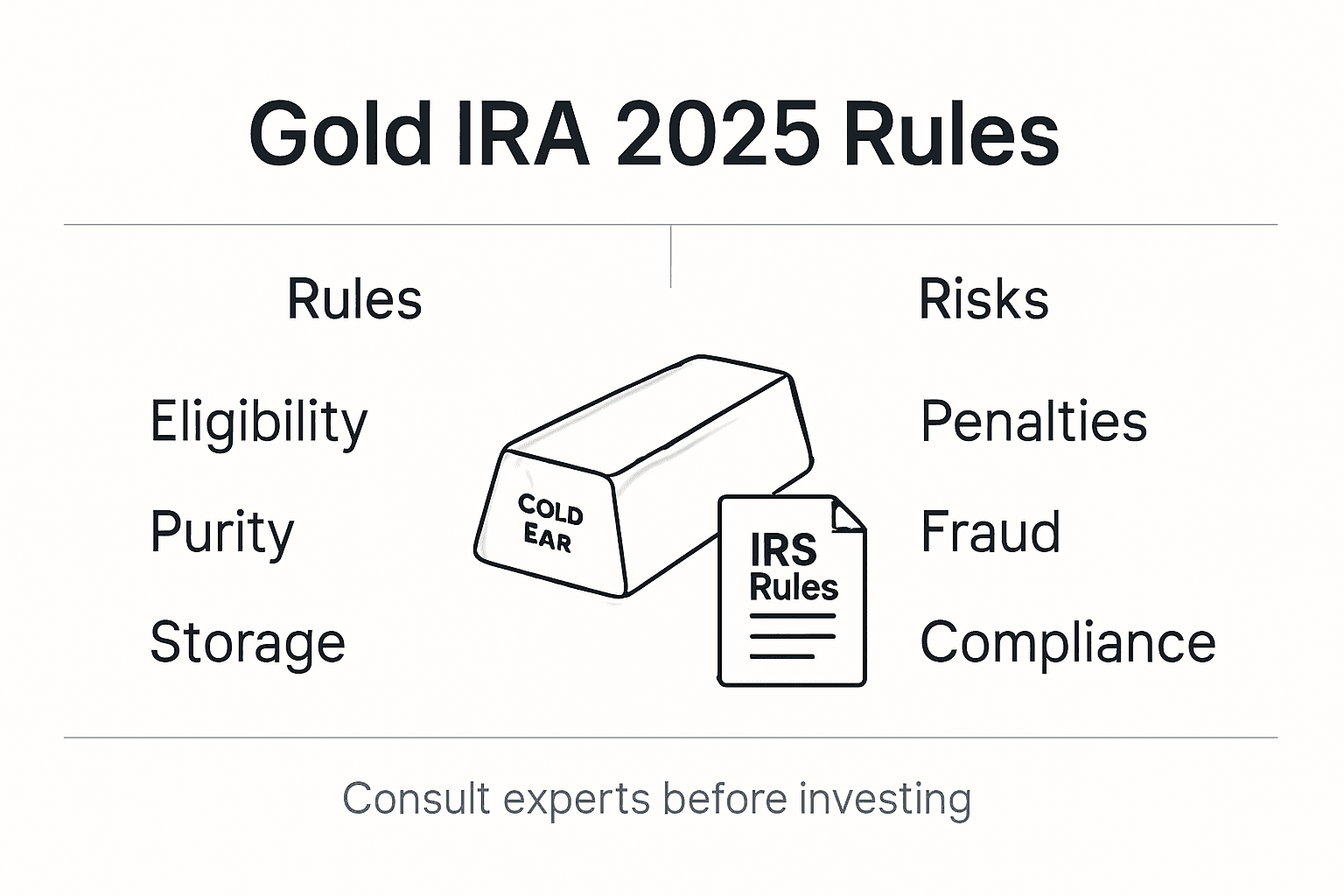
Pro tip: Consult a tax professional specialized in precious metal IRAs before making any distributions to fully understand the potential tax consequences and minimize unexpected financial penalties.
Risks, Compliance Challenges, and Common Mistakes
Gold IRA investments present a complex landscape of regulatory risks that demand meticulous attention from investors. The intricate nature of these specialized retirement accounts creates multiple potential pitfalls, with even minor oversights potentially resulting in significant financial consequences. Investors must navigate a narrow path of compliance, understanding that the IRS maintains extraordinarily strict guidelines governing precious metal retirement investments.
One of the most prevalent risks involves navigating the nuanced requirements for metal eligibility and storage. IRS regulations mandate precise standards for metal purity, approved coin types, and authorized storage facilities, with violations potentially triggering immediate tax penalties or complete disqualification of the retirement account. Common mistakes include purchasing collectible or non-approved coins, attempting to personally store IRA metals, or failing to work with properly credentialed custodians. These errors can transform what seems like a prudent investment strategy into a costly tax liability.
Fraudulent marketing practices pose another significant risk in the Gold IRA marketplace. Unscrupulous dealers often target investors with aggressive sales tactics, promoting overpriced numismatic coins that do not meet IRS standards or provide genuine investment value. These tactics can lead investors to make purchases that compromise their retirement portfolio’s integrity, with some unethical vendors deliberately exploiting investors’ limited understanding of complex IRA regulations. Comprehensive due diligence, including thorough background checks on potential custodians and metal dealers, becomes essential in mitigating these potential risks.
Pro tip: Request comprehensive documentation of metal eligibility and conduct independent verification of all investment claims before finalizing any Gold IRA transactions.
The following table highlights the main risks of Gold IRAs and tips to avoid costly mistakes:
| Common Risk | Example Scenario | Prevention Strategy |
|---|---|---|
| Non-compliant metals | Buying collectible coins | Consult official IRS guidelines |
| Improper storage | Home storage of metals | Use IRS-approved depositories |
| Fraudulent marketing | Overpriced coins by dealers | Vet dealers and request documentation |
| Custodian errors | Unqualified custodian | Verify IRS approval and audit history |
Navigate the Complex Regulatory Landscape of Gold IRAs with Confidence
Understanding the intricate rules and compliance challenges of Gold IRAs is essential to protect your retirement portfolio from costly mistakes and penalties. The article highlights critical pain points such as strict IRS purity standards, selecting an IRS-approved custodian, and avoiding fraudulent marketing schemes. These challenges can feel overwhelming but do not have to stand in your way of securing a diversified and inflation-resistant retirement investment.

Empower your investment decisions by exploring trusted, thoroughly reviewed precious metals companies on Gold Ranking Trends. We provide detailed profiles, transparent ratings, and customer feedback that help you identify top-tier custodians and reputable dealers who comply fully with IRS regulations. Act now to safeguard your future by leveraging expert analyses and comparing the best Gold IRA providers. Visit Gold Ranking Trends today to receive a free gold investment kit and start making informed, compliant choices with your retirement savings.
Frequently Asked Questions
What is a Gold IRA?
A Gold IRA is a specialized individual retirement account that allows investors to hold physical precious metals, such as gold, within a tax-advantaged retirement portfolio, diversifying investments beyond traditional stocks and bonds.
What are the IRS requirements for precious metals in a Gold IRA?
The IRS mandates that eligible metals must meet specific purity standards—gold must be at least 99.5% pure. Additionally, approved coins and bars must come from national government mints or accredited refineries and cannot be personally stored by the investor.
What role do custodians play in Gold IRAs?
Custodians are IRS-approved financial institutions that manage Gold IRAs, ensuring compliance with tax regulations, arranging the secure storage of precious metals, and maintaining detailed records of all transactions and assets held in the account.
What are the tax implications of withdrawing from a Gold IRA?
Withdrawals from a traditional Gold IRA are treated as ordinary taxable income, and taking distributions before age 59½ can incur a 10% early withdrawal penalty. Roth Gold IRAs offer tax-free qualified distributions with no required minimum distributions during the account holder’s lifetime.