Role of IRA Custodians – Why Security Matters
Role of IRA Custodians – Why Security Matters

Most American investors are surprised to learn that IRA custodians do not offer investment advice or guarantee asset safety. For those prioritizing security and transparency in retirement planning, especially through gold IRAs, understanding the true role of these institutions is crucial. With more than 40 million Americans relying on IRAs for retirement, choosing a reputable custodian with clear fee structures and strong customer satisfaction can make all the difference in safeguarding your future.
Table of Contents
- IRA Custodians Defined And Common Myths
- Types Of Custodians And Their Distinctions
- Custodian Responsibilities And Account Management
- IRS Compliance And Legal Requirements
- Fees, Risks, And Choosing The Right Custodian
Key Takeaways
| Point | Details |
|---|---|
| IRA Custodians Have Administrative Responsibilities | Custodians hold and safeguard retirement assets but do not provide investment advice or guarantee performance. |
| Types of Custodians Vary in Functionality | Traditional custodians focus on standard investments, while self-directed custodians offer greater flexibility with alternative assets. |
| Understanding Fees is Essential | IRA custodians may charge various fees that can impact long-term savings; investors should compare costs before selecting a custodian. |
| Compliance and Security are Critical | Custodians must adhere to strict regulatory requirements to protect investor assets; request compliance reports for assurance. |
IRA custodians defined and common myths
An IRA custodian is an IRS-approved financial institution responsible for holding and safeguarding retirement account assets. Unlike popular misconceptions, these entities play a critical administrative role without providing direct investment guidance. Third-party custodians serve as intermediaries between investors and their retirement investments, ensuring regulatory compliance and proper asset management.
Custodians perform several essential functions that many investors misunderstand. Their primary responsibilities include:
- Maintaining accurate account records
- Processing transactions
- Submitting required tax documentation
- Preserving the account’s tax-advantaged status
IRS-approved institutions like banks and investment companies can serve as custodians, with variations depending on the type of IRA. Self-directed IRA custodians offer more flexibility, allowing investments in alternative assets such as precious metals and real estate. Traditional custodians typically manage standard securities and provide more limited investment options.
Common myths about IRA custodians can lead investors astray. Many mistakenly believe custodians will:
- Provide investment advice
- Verify the quality or safety of investments
- Recommend specific investment strategies
- Protect against fraudulent investment opportunities
In reality, custodians have a narrow, administrative role. Investors must conduct their own due diligence and understand that custodians do not endorse or guarantee investment performance.
Pro tip: Always request a comprehensive fee schedule and understand your custodian’s specific services before opening an IRA to avoid unexpected costs and misconceptions.
Types of custodians and their distinctions
IRA custodians are not a one-size-fits-all solution. Third-party custodians exhibit significant variations in their structure, capabilities, and investment options, making it crucial for investors to understand the key distinctions between different types.
The primary categories of IRA custodians include:
- Traditional Custodians
- Focus on standard securities like stocks, bonds, and mutual funds
- Provide more structured investment platforms
- Often offer integrated investment advice and products
- Typically managed by banks and established financial institutions
- Self-Directed Custodians
- Allow investments in alternative assets
- Provide greater investment flexibility
- Enable purchases of real estate, precious metals, private equity
- Require more investor research and due diligence
IRS-approved financial institutions can serve different custodial roles depending on the specific retirement account structure. Some specialize in specific investment types, while others offer broader investment options. The key differentiator is the level of investor control and the range of permissible investments.

Each custodian type carries unique advantages and limitations. Traditional custodians offer streamlined, managed investment experiences, while self-directed custodians provide maximum investment autonomy. Investors must carefully evaluate their financial goals, risk tolerance, and desired level of personal investment management when selecting a custodian.
Here’s how traditional and self-directed IRA custodians differ in key areas:
| Criteria | Traditional Custodian | Self-Directed Custodian |
|---|---|---|
| Investment Options | Stocks, bonds, mutual funds | Real estate, precious metals, private equity |
| Investor Control | Limited; managed platform | Maximum; full investment choice |
| Advice Availability | Often included with account | Rarely provided; investor-driven |
| Regulatory Complexity | Standardized and established | More complex; requires investor diligence |
| Risk Exposure | Lower due to mainstream assets | Higher with non-traditional investments |
Pro tip: Request comprehensive documentation from potential custodians, comparing their fee structures, investment options, and administrative capabilities before making a final selection.
Custodian responsibilities and account management
IRA custodians play a critical role in managing retirement accounts, serving as financial guardians with specific administrative responsibilities. Custodians function as specialized financial gatekeepers responsible for safeguarding assets, processing transactions, and ensuring regulatory compliance without making direct investment decisions.
Their core responsibilities encompass several key areas:
- Secure asset storage and protection
- Transaction processing and verification
- Maintaining accurate financial records
- Reporting to tax authorities
- Executing authorized account instructions
- Tracking investment performance
Financial institutions must authenticate and execute instructions with ordinary care, following strict protocols for handling account transactions. This includes managing interest payments, processing securities liquidation, and protecting against unauthorized activities. Custodians operate under rigorous regulatory frameworks that demand meticulous attention to detail and robust security measures.
The landscape of account management involves complex risk management strategies. Custodians must continuously monitor potential threats such as:
- Cybersecurity vulnerabilities
- Transaction processing errors
- Compliance regulation changes
- Potential unauthorized account access
Investors rely on these institutions to maintain the integrity of their retirement accounts, making the custodian’s role fundamentally about trust, security, and precise administrative management.
Pro tip: Request a comprehensive security and compliance audit report from your potential custodian to thoroughly understand their risk management protocols and protective measures.
IRS compliance and legal requirements
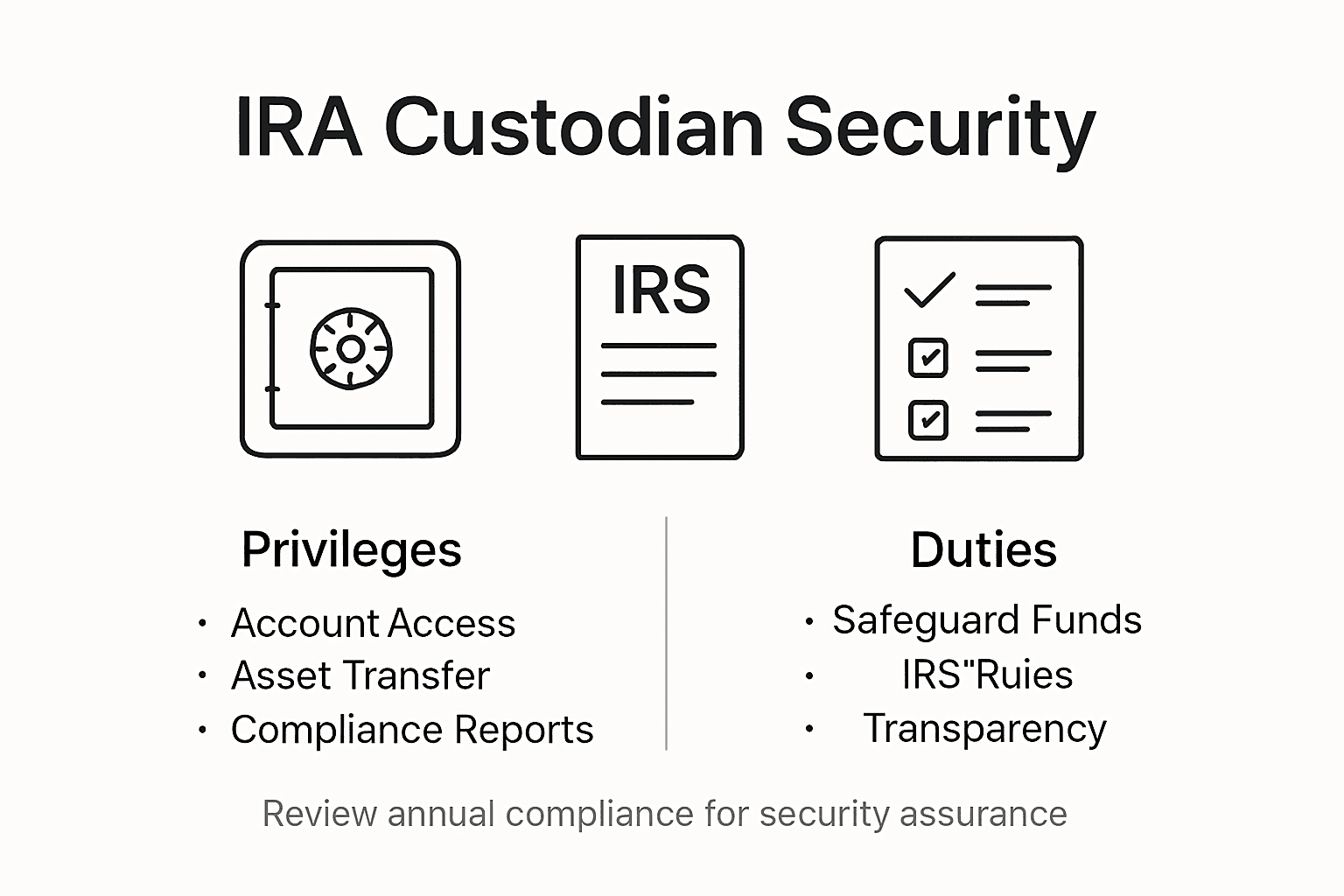
IRA custodians operate within a complex regulatory landscape that demands strict adherence to federal guidelines and financial oversight. The regulatory framework governing IRAs involves comprehensive monitoring by multiple agencies, including the IRS for nonbank custodians and FDIC for bank-based institutions, ensuring robust protection of retirement assets.
Key compliance requirements for IRA custodians include:
- Conducting annual financial audits
- Maintaining detailed record-keeping systems
- Segregating client assets
- Implementing robust security protocols
- Reporting transactions to tax authorities
- Preventing prohibited investment activities
Investment advisers must adhere to strict custody regulations, which mandate specific procedures for protecting client funds. These regulations require:
- Holding client funds in qualified custodial accounts
- Providing quarterly account statements
- Ensuring independent financial verification
- Maintaining transparent communication with account holders
The legal framework surrounding IRA custodians is designed to protect investors from potential financial misconduct. Custodians must demonstrate ongoing fiduciary responsibility, financial stability, and a commitment to maintaining the integrity of retirement accounts. This includes continuous monitoring of investment activities, preventing unauthorized transactions, and ensuring that all account management practices comply with federal regulations.
Pro tip: Request an annual compliance report from your IRA custodian to verify their adherence to IRS regulations and understand the specific measures protecting your retirement investments.
Fees, risks, and choosing the right custodian
Navigating the complex landscape of IRA custodian selection requires a comprehensive understanding of potential financial implications and associated risks. Self-directed IRA investments present unique challenges that demand careful consideration of fees, regulatory protections, and potential investment vulnerabilities.
Typical fee structures for IRA custodians include:
- Account setup fees
- Annual maintenance charges
- Transaction fees
- Investment-specific commissions
- Asset management expenses
IRA account fees can significantly impact long-term retirement savings, making it crucial to understand and minimize unnecessary expenses. Some custodians offer low-fee or no-fee options, which can help preserve more of your investment returns over time. Investors should carefully compare fee schedules and understand the total cost structure before committing to a specific custodian.
This table summarizes typical IRA custodian fees and their long-term impact:
| Fee Type | Typical Cost Range | Potential Impact Over Time |
|---|---|---|
| Account Setup Fee | $25 - $50 one-time | Reduces initial account value |
| Annual Maintenance | $50 - $200 yearly | Erodes growth if unmanaged |
| Transaction Fee | $5 - $50 per trade | Frequent transactions increase costs |
| Asset Management | 0.25% - 1% of assets | Compounds cost; lowers net returns |
Risk management is paramount when selecting an IRA custodian. Key risks to evaluate include:
- Potential for fraudulent investment opportunities
- Limited regulatory protections in self-directed accounts
- Liquidity challenges with alternative assets
- Lack of investment vetting by custodians
- Volatile performance of non-traditional investments
Successful custodian selection requires thorough due diligence, comparing multiple providers, understanding their specific capabilities, and assessing their track record of maintaining investor interests.
Pro tip: Request a comprehensive fee breakdown and investment risk assessment from potential custodians, comparing their transparency, regulatory compliance, and historical performance before making a final decision.
Secure Your Retirement With Trusted IRA Custodians and Gold Investments
Understanding the critical role of IRA custodians in protecting your retirement assets is just the first step toward a secure financial future. This article highlights key challenges like safeguarding assets, adhering to IRS compliance, and managing investment risks that every investor faces. If you want to avoid costly fees and vulnerabilities associated with self-directed IRAs, you need a trusted guide who can help you identify reputable custodians and gold investment companies with proven transparency and reliability.

Discover top-rated gold IRA companies reviewed for their security practices, fee transparency, and customer satisfaction at Gold Ranking Trends. Don’t leave your retirement exposed to uncertainty. Visit Gold Ranking Trends now to access expert ratings, compare trusted custodians, and request your free gold investment kit. Safeguard your future by making informed decisions backed by verified reviews and real customer feedback today.
Frequently Asked Questions
What is the primary role of an IRA custodian?
An IRA custodian is an IRS-approved financial institution responsible for safeguarding retirement account assets, processing transactions, maintaining accurate account records, and ensuring compliance with regulatory requirements.
How do traditional and self-directed IRA custodians differ?
Traditional custodians focus on standard securities such as stocks and bonds, offering structured investment platforms, while self-directed custodians allow for investments in alternative assets like real estate and precious metals, providing greater investment flexibility.
What common misconceptions do investors have about IRA custodians?
Many investors mistakenly believe that custodians provide investment advice, verify the quality of investments, or protect against fraudulent opportunities. In reality, custodians have a strictly administrative role and investors must conduct their own due diligence.
What should I consider when choosing an IRA custodian?
When selecting an IRA custodian, it’s important to evaluate fee structures, available investment options, security measures, and their historical track record in compliance and client service. Thorough research can help identify the right custodian for your needs.