What Affects Gold Prices – Key Insights For US Retirement
What Affects Gold Prices – Key Insights For US Retirement

A stunning ninety percent of American retirees with substantial assets consider gold a core part of long-term wealth preservation, yet many misunderstand what actually moves gold prices. For high-net-worth American investors, Gold IRAs are more than just a hedge—they are a strategic tool shaped by complex economic forces and global events. This guide exposes common misconceptions and uncovers the factors that truly drive gold’s value, so you can make informed decisions about your retirement portfolio.
Table of Contents
- Gold Pricing Basics And Common Misconceptions
- Major Drivers Of Gold Price Fluctuations
- Impact Of Inflation And Dollar Trends
- Role Of Central Banks And Global Events
- Risks, Costs, And Gold IRA Implications
Key Takeaways
| Point | Details |
|---|---|
| Gold Pricing Is Complex | Gold prices are influenced by various economic factors including supply, demand, and geopolitical tensions. |
| Inflation Hedging Is Not Certain | Gold does not consistently serve as an inflation hedge; its value fluctuates with market conditions and investor sentiment. |
| Central Banks Significantly Influence Prices | Changes in central bank gold reserves can lead to substantial market movements, necessitating close monitoring. |
| Gold IRAs Have Unique Challenges | Investing in Gold IRAs involves regulatory complexities and costs that differ from traditional IRAs, requiring careful planning. |
Gold Pricing Basics And Common Misconceptions
Understanding gold prices requires moving beyond simplistic assumptions and recognizing the complex dynamics that influence this precious metal’s valuation. Gold’s role as an investment asset has evolved significantly, transforming from a traditional monetary standard to a sophisticated financial instrument traded globally.
Gold pricing is not a straightforward calculation but a nuanced interplay of multiple economic factors. Contrary to popular belief, gold is not a guaranteed inflation hedge or a consistently stable investment. Its value fluctuates based on intricate global market mechanisms, including supply and demand, geopolitical tensions, currency strength, and investor sentiment. The London Gold Fixing and over-the-counter markets play crucial roles in establishing daily gold prices, reflecting real-time economic conditions and trader expectations.
Several common misconceptions persist about gold pricing. Many investors mistakenly believe gold always increases in value during economic uncertainty. While gold often performs well during market turbulence, its price is not immune to speculative trading and can experience significant volatility. Factors like central bank policies, industrial demand, mining production, and global economic indicators all contribute to gold’s complex pricing structure. Sophisticated investors understand gold as part of a diversified portfolio strategy rather than a singular solution to financial security.
Pro tip: Always analyze multiple economic indicators and consult financial professionals before making significant gold investment decisions to understand the nuanced factors affecting gold prices.
Major Drivers Of Gold Price Fluctuations
Gold prices are influenced by a complex web of interconnected economic and geopolitical factors that create significant market volatility. Macroeconomic factors play a critical role in determining the precious metal’s valuation, with investors closely monitoring multiple dynamic indicators that can trigger substantial price shifts.
Several key drivers consistently impact gold pricing. Economic uncertainty emerges as a primary catalyst, with investors traditionally viewing gold as a safe-haven asset during periods of financial instability. Real interest rates represent another crucial determinant, as lower rates typically make gold more attractive compared to interest-bearing investments. Inflation expectations also significantly influence gold prices, with investors using the metal as a potential hedge against currency devaluation and economic unpredictability.
Geopolitical tensions and monetary policies further contribute to gold price fluctuations. Global events such as political conflicts, trade disputes, and major economic policy changes can rapidly alter investor sentiment and trigger substantial price movements. Central bank purchasing decisions, currency exchange rates, and international market sentiment create additional layers of complexity in gold valuation. Sophisticated investors understand that gold prices are not determined by a single factor but by a sophisticated interplay of global economic dynamics.
Here’s a quick comparison of how different economic drivers influence gold prices:
| Factor | Typical Effect on Gold | Example Impact |
|---|---|---|
| Economic Uncertainty | Increases demand | Safe-haven buying during crises |
| Real Interest Rates | Inverse correlation | Lower rates boost gold appeal |
| Inflation Expectations | Supports price rises | Anticipation leads to investment |
| Geopolitical Tensions | Drives volatility | Conflicts cause price spikes |
Pro tip: Monitor multiple economic indicators simultaneously and avoid making investment decisions based on isolated market signals to develop a more comprehensive understanding of potential gold price movements.
Impact Of Inflation And Dollar Trends
Understanding the intricate relationship between gold prices, inflation, and US dollar trends requires a nuanced approach to investment strategy. Inflation’s complex impact on gold challenges many traditional investment assumptions, revealing a dynamic and often unpredictable connection that demands careful analysis.
The Federal Reserve Bank of Chicago research highlights the imperfect nature of gold as an inflation hedge. Gold prices do not move in a simple, predictable correlation with inflation rates. Instead, they respond to broader economic signals, including inflation expectations, real interest rates, and overall market sentiment. During periods of high economic uncertainty, gold tends to appreciate, but this relationship is far from guaranteed. Investors must recognize that gold’s value fluctuates based on complex macroeconomic indicators rather than following a straightforward inflation-protection mechanism.
US dollar strength plays a critical role in gold pricing dynamics. Dollar trends significantly influence gold valuation, with a weaker dollar typically supporting higher gold prices. This inverse relationship stems from gold’s status as a global reserve asset. When the US dollar weakens, investors often turn to gold as an alternative store of value, driving up demand and prices. Sophisticated retirement investors understand that monitoring currency trends is essential for comprehending potential gold price movements.

Pro tip: Develop a comprehensive investment approach that considers multiple economic indicators rather than relying solely on gold’s perceived inflation-hedging capabilities.
Role Of Central Banks And Global Events
Central banks play a pivotal role in shaping global gold markets, wielding significant influence through their strategic reserve management and monetary policies. Gold reserves by country demonstrate the complex relationship between national financial strategies and precious metal holdings, revealing how geopolitical considerations directly impact gold valuation.
The intricate dynamics of central bank activities extend far beyond simple asset management. These institutions use gold reserves as a critical tool for promoting monetary stability and managing economic uncertainties. During periods of global financial tension, central banks often adjust their gold holdings as a strategic response to economic challenges. Their purchasing and selling decisions can create substantial market movements, with even subtle shifts in reserve strategies potentially triggering significant price fluctuations in the global gold market.
Federal Reserve’s custodial role highlights the nuanced relationship between government institutions and gold assets. While the U.S. Federal Reserve does not directly own gold, it serves as a crucial custodian for gold owned by the U.S. Treasury and foreign central banks. This mechanism underscores the complex interconnectedness of global financial institutions and their approach to managing precious metal reserves. Geopolitical events, economic sanctions, trade tensions, and international monetary policies can all precipitate strategic changes in gold reserve management, creating ripple effects throughout global financial markets.
Pro tip: Monitor official announcements from major central banks to gain early insights into potential shifts in gold market dynamics.
Risks, Costs, And Gold IRA Implications
Investing in a Gold IRA requires careful consideration of complex regulatory and financial dynamics that can significantly impact retirement planning. IRA regulations for precious metals establish strict guidelines that investors must navigate to maintain compliance and optimize their investment strategy.
Gold IRAs come with unique risks and cost structures that differentiate them from traditional retirement accounts. Storage fees, custodian expenses, and physical gold acquisition costs can substantially reduce potential returns. The IRS mandates that gold held in these accounts must meet specific purity standards and be stored in approved depositories, adding layers of complexity and expense. Gold IRA investment frameworks reveal that while these accounts offer portfolio diversification, they also introduce challenges such as limited liquidity and potentially higher transaction costs compared to conventional investment vehicles.
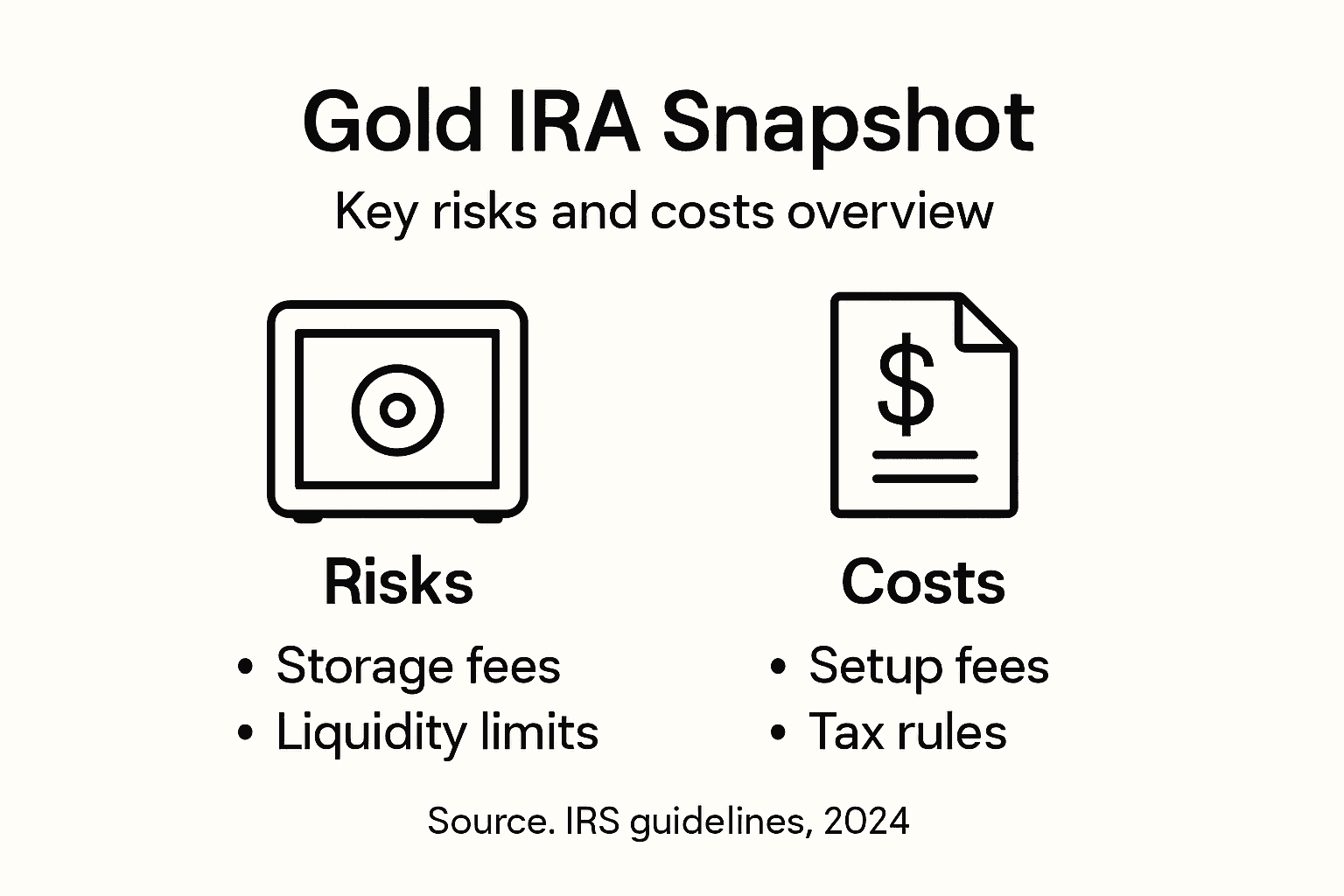
Tax implications represent another critical dimension of Gold IRA investments. Investors must understand the nuanced rules surrounding contributions, distributions, and potential penalties. The specialized nature of these accounts means that standard retirement account strategies may not apply, requiring sophisticated financial planning and potentially professional guidance to optimize tax efficiency and minimize potential regulatory risks.
Use this summary to understand the main differences between Gold IRAs and Traditional IRAs:
| Feature | Gold IRA Requirements | Traditional IRA Requirements |
|---|---|---|
| Eligible Assets | Approved precious metals | Stocks, bonds, mutual funds |
| Storage | Must use approved depository | Held by brokerage or custodian |
| Liquidity | Generally lower | Typically higher |
| Regulatory Costs | Often higher due to storage | Usually lower |
Pro tip: Consult a qualified tax professional who specializes in self-directed IRAs to fully understand the complex regulatory landscape and potential financial implications of gold retirement investments.
Secure Your Retirement with Expert Gold Investment Insights
Navigating the complex factors that affect gold prices can feel overwhelming. From inflation and US dollar trends to central bank moves and regulatory challenges linked to Gold IRAs, making informed decisions is critical for protecting your retirement. This article highlights the need to understand economic drivers and the unique risks involved in gold investments. If you are concerned about volatility, fees, or how to choose the right Gold IRA provider, you are not alone. Many investors face these exact challenges when trying to diversify their portfolios with precious metals.

Take control of your retirement strategy today by exploring trusted companies reviewed and ranked at goldrankingtrends.info. Our platform offers detailed ratings based on customer satisfaction, transparency, fees, and offerings so you can compare the best Gold IRA providers with confidence. Start your journey with a free gold kit or an investment assessment and gain clarity on what truly affects gold prices and how to benefit. Visit Explore Top Gold IRA Companies now to discover solutions tailored to your financial goals and safeguard your retirement with smart, trusted choices.
Frequently Asked Questions
What factors primarily influence gold prices?
Gold prices are influenced by a variety of interconnected factors including economic uncertainty, real interest rates, inflation expectations, geopolitical tensions, and central bank policies. These elements create significant market volatility and affect investor sentiment.
How does inflation impact gold prices?
Inflation impacts gold prices in a complex manner. While many view gold as an inflation hedge, its price does not always correlate directly with inflation rates. Instead, gold often reflects broader economic signals and investor sentiment during periods of economic uncertainty.
What role do central banks play in gold pricing?
Central banks significantly influence gold prices through their reserve management and monetary policies. Their decisions to buy or sell gold can create substantial market movements, as they use gold reserves to promote monetary stability during economic challenges.
What are the risks associated with investing in a Gold IRA?
Investing in a Gold IRA involves several risks, including storage fees, custodian expenses, and market volatility. The IRS has strict regulations regarding the types of gold that can be held, which adds complexity to managing such accounts and may require professional financial guidance.