Why Diversify with Gold in 2026: Stability for Retirement
Why Diversify with Gold in 2026: Stability for Retirement

Most American retirees worry that their hard-earned savings could shrink as markets fluctuate and inflation rises. Over $1 trillion in retirement assets shifted toward alternative investments in recent years, reflecting growing concerns about economic uncertainty. Gold diversification stands out as a proven strategy for Republican retirees committed to protecting their nest eggs. This guide explains how adding gold to your portfolio may offer reliable security when traditional investments become unpredictable.
Table of Contents
- Gold Diversification Defined And Debunked
- Types Of Gold Retirement Investments Explained
- How Gold Mitigates Inflation And Market Shocks
- Legal Rules And Tax Implications For Gold Iras
- Risks, Costs, And Common Investor Mistakes
- Comparing Gold With Other Safe-Haven Assets
Key Takeaways
| Point | Details |
|---|---|
| Gold Diversification | Allocating a portion of your portfolio to gold can effectively manage financial risk and protect against market volatility. |
| Types of Gold Investments | Options include physical gold, gold ETFs, gold mutual funds, and gold IRAs, each with unique benefits and trade-offs. |
| Inflation Hedge | Gold historically appreciates during inflation and economic downturns, serving as a stabilizing asset in investment portfolios. |
| Legal Compliance | Understanding IRS regulations for gold IRAs is crucial for maximizing tax benefits and avoiding penalties in retirement accounts. |
Gold Diversification Defined and Debunked
Investors seeking retirement stability increasingly turn to gold diversification as a strategic approach to managing financial risk. Unlike traditional investment strategies that rely solely on stocks and bonds, gold offers a unique hedge against economic uncertainty. Central banks increasingly view gold as a strategic asset during periods of market volatility, demonstrating its enduring value as a diversification tool.
At its core, gold diversification involves allocating a percentage of your investment portfolio to physical gold or gold-related financial instruments. This strategy leverages gold’s distinctive characteristic of having low correlation with other asset classes, meaning gold prices often move independently of stocks and bonds. Investors use gold to mitigate portfolio risks by creating a buffer against potential market downturns, inflation, and geopolitical instability.
The mechanics of gold diversification are relatively straightforward. Investors can choose from multiple approaches: purchasing physical gold bullion, investing in gold exchange traded funds (ETFs), acquiring gold mining stocks, or establishing a gold Individual Retirement Account (IRA). Each method offers unique advantages and potential drawbacks. Physical gold provides tangible asset ownership, while ETFs offer greater liquidity. Gold mining stocks can provide potential growth, and gold IRAs deliver tax-advantaged retirement investment opportunities.
Pro Tip: Before implementing a gold diversification strategy, consult with a financial advisor who specializes in precious metals investments to develop a personalized approach tailored to your specific retirement goals.
Types of Gold Retirement Investments Explained
Retirement investors have multiple strategic options for incorporating gold into their investment portfolios. Gold IRAs represent a specialized investment vehicle that allows individuals to hold physical precious metals within a tax-advantaged retirement account. These self-directed accounts provide a unique opportunity to diversify retirement savings beyond traditional stocks and bonds, offering protection against economic volatility.
The primary types of gold retirement investments include physical gold, gold exchange traded funds (ETFs), gold mutual funds, and gold-backed strategic investment assets. Physical gold involves purchasing actual bullion coins or bars stored in approved depositories, which must meet specific IRS purity standards. Gold ETFs provide greater liquidity, allowing investors to trade gold-related securities without managing physical storage. Gold mutual funds offer exposure to gold mining companies, providing potential growth through stock performance rather than direct metal ownership.
Each gold investment type carries distinct advantages and considerations. Physical gold offers tangible asset ownership and direct inflation protection. Gold ETFs provide easier trading and lower storage costs. Gold mining stocks can generate potential dividend income, while gold IRAs deliver tax-advantaged investment structures. Selecting the right gold investment strategy depends on individual retirement goals, risk tolerance, and long-term financial planning objectives.

Here’s a concise comparison of popular gold retirement investment types:
| Investment Type | Liquidity Level | Potential for Growth | Tax Advantages |
|---|---|---|---|
| Physical Gold | Low (requires sale) | Limited, tied to gold | None unless in IRA |
| Gold ETF | High (easy trading) | Moderate, follows gold | Taxable outside IRAs |
| Gold Mutual Funds | Moderate | Can benefit from mining | Taxable outside IRAs |
| Gold IRA | Varies (withdrawal) | Depends on structure | Tax-deferred or tax-free |
Pro Tip: Consult a qualified financial advisor to assess which gold investment approach best aligns with your specific retirement portfolio and risk profile.
How Gold Mitigates Inflation and Market Shocks
Gold serves as a powerful defensive asset in retirement portfolios, providing critical protection against economic uncertainty. Gold’s role as a safe haven asset becomes particularly pronounced during periods of market volatility, economic downturns, and inflationary pressures. Unlike traditional financial instruments that can rapidly lose value, gold maintains intrinsic worth and often appreciates when other assets decline, making it a strategic hedge for conservative investors.
The mechanism of gold’s inflation mitigation is rooted in its historical performance and inherent value. Dual market demand supports gold’s stability through investment and consumer markets, creating a natural buffer against economic shocks. When traditional currencies lose purchasing power, gold typically increases in nominal value, effectively preserving wealth. This counter-cyclical behavior means gold tends to perform well during economic uncertainties, rising when stock markets experience turbulence or when government monetary policies trigger inflationary conditions.
Investors can leverage gold’s protective qualities through multiple investment strategies. Physical gold bullion, gold ETFs, and gold-backed retirement accounts offer different levels of exposure and risk management. During hyperinflation scenarios or significant market disruptions, gold has consistently demonstrated its ability to maintain value, providing a crucial stabilizing element in diversified investment portfolios. Key benefits of gold investments include wealth preservation, portfolio diversification, and protection against systemic financial risks.
Pro Tip: Allocate between 5% to 10% of your retirement portfolio to gold investments to optimize risk protection without over-concentrating your assets.
Legal Rules and Tax Implications for Gold IRAs
Gold IRAs operate under strict federal regulations that define their unique tax treatment and investment parameters. Specific IRS guidelines govern precious metal investments in retirement accounts, establishing precise rules for metal purity, storage, and custodial requirements. The Taxpayer Relief Act of 1997 expanded retirement investment options, allowing investors to include approved gold and precious metal assets within self-directed individual retirement accounts.
The tax implications of gold IRAs differ significantly between traditional and Roth account structures. IRS regulations outline specific withdrawal and distribution rules that directly impact taxation. Traditional gold IRAs offer tax-deferred growth, meaning investors pay taxes upon withdrawal, while Roth gold IRAs provide tax-free distributions if certain conditions are met. Critically, early withdrawals before age 59½ may trigger substantial penalties and immediate tax obligations, making strategic planning essential.
Investors must adhere to several key legal requirements when establishing a gold IRA. Physical gold must meet minimum 99.5% purity standards and be stored in IRS-approved depositories. Compliance with gold IRA setup guidelines requires working with specialized custodians who manage the complex reporting and storage regulations. Prohibited transactions or improper handling can result in immediate account disqualification and potential tax penalties, underscoring the importance of professional guidance.
Pro Tip: Consult a tax professional specializing in retirement accounts to understand the specific tax implications and potential strategic advantages of your gold IRA investment structure.
Risks, Costs, and Common Investor Mistakes
Gold investment requires sophisticated understanding of potential pitfalls and strategic challenges. Gold market investment dynamics reveal complex risks that can derail retirement planning, including price volatility, unexpected transaction costs, and market speculation factors. Investors must navigate these challenges with careful research and strategic planning to protect their financial interests.
The most prevalent investor mistakes stem from fundamental misunderstandings about gold’s role in portfolio diversification. Strategic asset management principles emphasize that gold should not be viewed as a quick-profit vehicle but as a long-term stability instrument. Common errors include over-concentrating investments in gold, misinterpreting premium costs versus spot prices, and failing to understand the nuanced relationship between gold values and broader economic indicators.
Critical cost considerations extend beyond purchase price. Investors encounter multiple expense categories including storage fees, insurance costs, custodial charges, and potential transaction expenses. Physical gold investments require secure storage in IRS-approved depositories, which adds substantial ongoing expenses. These costs can significantly erode potential returns if not carefully managed, making transparent fee structures and comprehensive cost analysis essential for responsible gold investment strategies.
Pro Tip: Request a comprehensive fee breakdown from potential gold IRA custodians before committing, and calculate total annual expenses to ensure they align with your investment objectives.
Comparing Gold with Other Safe-Haven Assets
Safe-haven investments represent critical strategies for protecting wealth during economic uncertainties. Gold’s unique role as a reserve asset distinguishes it from traditional safe-haven options like government bonds, treasury bills, and foreign currencies. Unlike these alternatives, gold maintains intrinsic value independent of governmental credit ratings or economic performance, providing investors a more resilient protection mechanism.
Traditional safe-haven assets each carry distinct advantages and limitations. Government bonds offer predictable returns but remain vulnerable to interest rate fluctuations. Cash reserves lose purchasing power during inflation, while foreign currencies experience volatility from geopolitical shifts. Gold provides comprehensive portfolio protection by maintaining value across different economic conditions, demonstrating remarkable stability during market disruptions and geopolitical tensions.
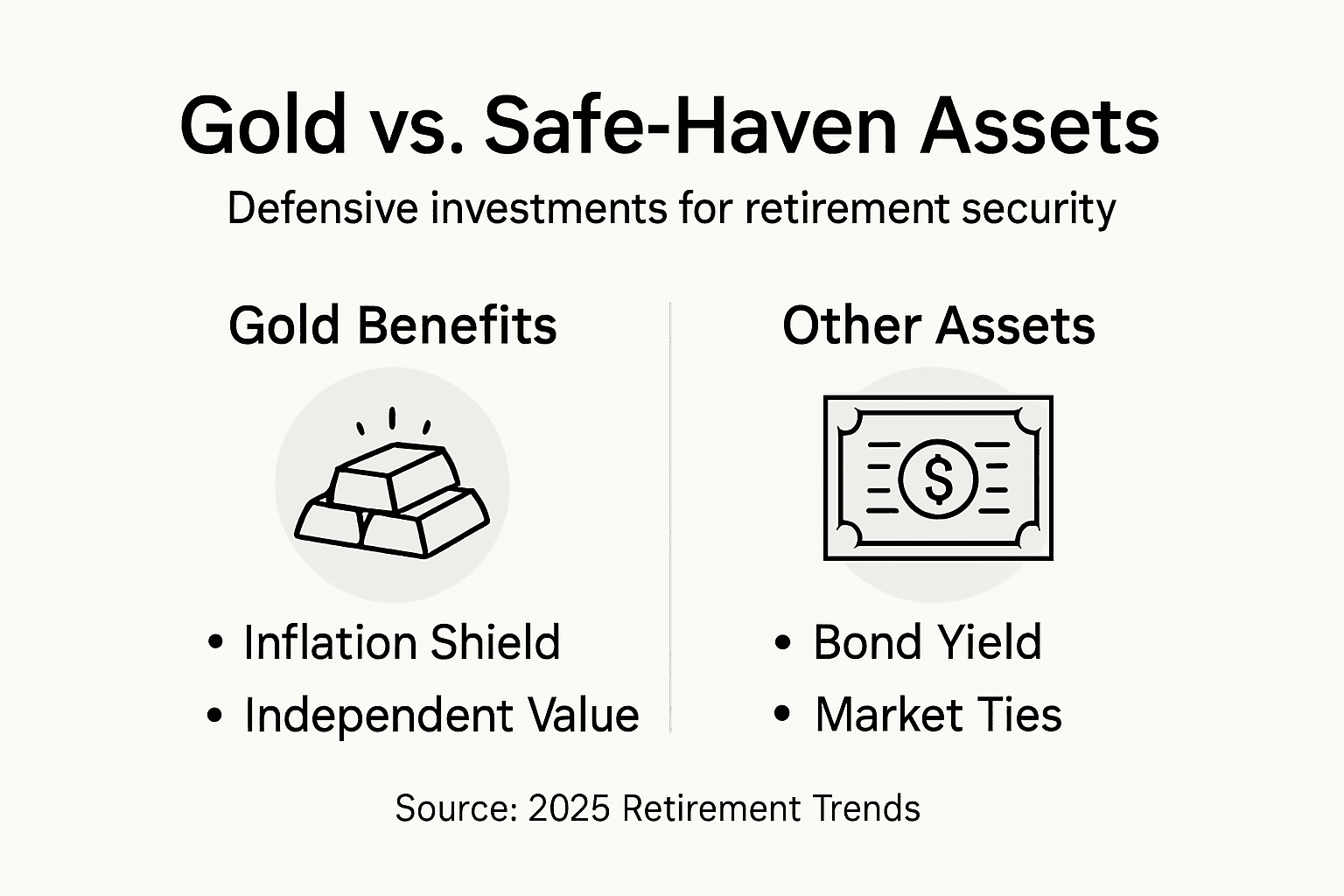
Investors should understand that gold’s performance differs fundamentally from other safe-haven instruments. While bonds generate fixed income and currencies represent liquid financial instruments, gold functions as a tangible asset with inherent value. Its low correlation with stock markets and currencies makes it an exceptional diversification tool. Physical gold, gold ETFs, and gold-backed securities offer varying levels of exposure, allowing investors to customize their risk management strategies.
The table below highlights how gold and other safe-haven assets respond to economic stress:
| Asset Type | Responds to Inflation | Impact of Market Volatility | Dependency on Government Credit |
|---|---|---|---|
| Gold | Preserves value | Price often rises | None |
| Government Bonds | Value may decrease | Can be volatile | High |
| Cash Reserves | Value declines | Stable but loses value | Moderate |
| Foreign Currency | Fluctuates | Can be unstable | Varies by country |
Pro Tip: Allocate no more than 10-15% of your portfolio to safe-haven assets, balancing gold with other defensive investment strategies to optimize long-term financial resilience.
Secure Your Retirement with Trusted Gold Diversification Solutions
The challenge of protecting your retirement savings from inflation and market volatility is clear. As the article highlights, incorporating gold into your portfolio offers essential stability and risk mitigation. But knowing how to navigate the many gold investment options and avoid costly mistakes can feel overwhelming. If you’re looking for expert guidance to make confident decisions about gold IRAs and precious metals investments, our platform is here to help.

Explore carefully curated and thoroughly reviewed top gold IRA companies at Gold Ranking Trends. Discover detailed customer satisfaction ratings, trust scores from BBB and Trustpilot, and transparent fee comparisons that empower you to select the best trusted partners for your retirement diversification strategy. Act now to take advantage of free gold investment kits, personalized assessments, and direct purchase opportunities so you can confidently build a resilient portfolio for 2026 and beyond. Start your gold retirement journey today by visiting our landing page and unlock the power of informed precious metals investing.
Frequently Asked Questions
What is gold diversification and why is it important for retirement?
Gold diversification involves allocating a portion of your investment portfolio to gold or gold-related instruments. It’s important for retirement as it serves as a hedge against economic uncertainty, inflation, and market volatility, helping to stabilize your overall financial strategy.
How does gold mitigate inflation and protect investments?
Gold maintains intrinsic value and typically appreciates during inflationary periods. Its counter-cyclical behavior means it often rises in value when traditional financial assets, like stocks and bonds, decline, thus preserving wealth and stabilizing your investment portfolio.
What are the different types of gold retirement investments available?
Investors can choose from various types of gold retirement investments, including physical gold, gold exchange-traded funds (ETFs), gold mutual funds, and gold-backed IRAs. Each type has unique advantages, such as liquidity, growth potential, and tax benefits.
What legal rules and tax implications are associated with gold IRAs?
Gold IRAs are subject to IRS regulations concerning metal purity, storage, and custodial requirements. They offer tax-deferred growth for traditional IRAs and tax-free distributions for Roth IRAs, but withdrawals before age 59½ may incur penalties, making it essential to adhere to IRS guidelines.